Shiga Prefecture Sights
This page is 80% complete. Last updated: June 17, 2023
by Philbert Ono

With Japan's largest lake in Lake Biwa, numerous National Treasures and Important Cultural Properties, and a feudal and cultural history of national importance, and traditional townscapes, Shiga offers nature lovers, cyclists, beachgoers, history buffs, architecture fans, religious pilgrims, and shutterbugs many sights.
Besides supplying water to millions of people in Kyoto and Osaka, Lake Biwa offers boat cruises to places like Chikubushima island, a nice cycling path around the lake (taking 2-3 days), and white-sand beaches like Omi-Maiko on the western shore popular with people coming from nearby Kyoto.
Although Shiga often identifies itself with Lake Biwa, it also has many other places of interest. Being next to Kyoto, Shiga (named Omi in the feudal era) has been a strategic residence for daimyo feudal lords like Oda Nobunaga (Azuchi Castle), Akechi Mitsuhide (Sakamoto Castle), Toyotomi Hideyoshi (Nagahama Castle), Yamauchi Kazutoyo and wife Chiyo, and Azai Nagamasa (Odani Castle).
Kyoto's Buddhist influence also spread to Shiga with numerous temples. Enryakuji is a massive temple complex on Mt. Hiei and the headquarters of the Tendai Sect. It is a World Heritage Site and National Treasure along with major Kyoto temples. Ishiyama-dera and Miidera temples in Otsu also have National Treasure buildings.
After Kyoto and Nara Prefectures, Shiga has the third highest number (178) of buildings (temples, shrines, etc.) designated as National Treasures or Important Cultural Properties. Shiga has 22 buildings which are National Treasures, the third highest number in Japan. Besides Buddhist temples, Shiga has Shinto shrines and Hikone Castle which are National Treasures. Hikone Castle is also another tourist jewel of Shiga, being only one of five castles in Japan designated as a National Treasure.
The Tokaido and Nakasendo Roads leading to Kyoto also pass through Shiga and there are remnants of the old shukuba post towns like Kusatsu and Tsuchiyama romanticized by woodblock artist Hiroshige. Hiroshige also depicted Omi Hakkei (Eight Views of Omi) as woodblock prints making places like the Ukimido Floating temple and Seta-no-Karahashi Bridge famous.
Shiga was also home to the Koga (Koka) ninja in the city of Koka. An authentic ninja house in its original location remains as well as a ninja amusement park. See the ninja's clever trickery in the house or dress up as a ninja and throw star-shaped knives at a target.
Shiga also has many seasonal sights in festivals (matsuri), cherry blossoms, autumn leaves, and Japanese gardens. Kaizu Osaki in northern Shiga is one of Japan's 100 Famous Cherry Blossoms Spots, along with Hokoen Park where Nagahama Castle is located. Autumn leaves go well with temples and shrines. The Koto Sanzan Temple Trio with National Treasure buildings in eastern Shiga are noted spots in fall. Major festivals include Sagicho Matsuri, Hachiman Matsuri, Nagahama Hikiyama Matsuri, Sanno Matsuri, Otsu Matsuri, Hino Matsuri, and Higashi-Omi Giant Kite Festival (currently suspended).
The main gateways to Shiga is Maibara Station (bullet train station) on the JR Tokaido Line in northern Shiga and Otsu, adjacent to Kyoto, down south. Being next to Kyoto, Shiga is also easily accessible from train stations in Kyoto such as Kyoto Station and Yamashina Station.

Shiga's major attractions are listed below. Click on the link to see photos.
Castles
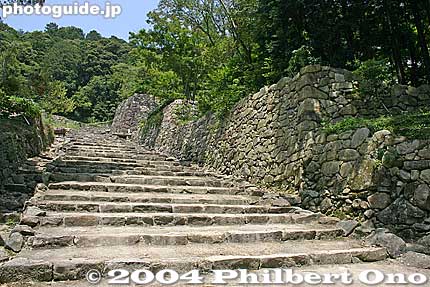 |
| Azuchi Castle still has much stone work remaining. |
- Hikone Castle 彦根城 - One of five castles in Japan designated as a National Treasure. ne of Shiga's most famous buildings and a National Treasure. The castle tower, turrets, and moats are well preserved and they give you a good glimpse into how a real castle looked like (especially the inside). It was the base of the Ii Clan, most notably Ii Naosuke (1815-1860), the 16th lord of the Hikone clan who served as the Chief Minister (Tairo) in the Tokugawa shogunate government. He was a key person in opening Japan to Western countries by signing the Treaty of Amity and Commerce (日米修好通商条約 Nichibei Shūkō Tsūshō Jōyaku) between the United States and Japan in 1858. He thus broke Japan's isolation from the world in the 19th century. Foreigners were then allowed to trade with Japan and take up residence in cities like Yokohama and Hakodate. From age 17 to 32, he lived and trained at Umoregi-no-ya 埋木舎 within the grounds of Hikone Castle. Ii was later assassinated in 1860 near Edo Castle by samurai radicals who sought to oust the foreign "barbarians." Near Hikone Station. Map
- Nagahama Castle 長浜城 - Nagahama Castle (reconstructed) in Nagahama, Shiga Prefecture is a lakeside castle within Hokoen Park. The original castle was built by Toyotomi Hideyoshi in the 16th century who lived in Nagahama Castle until 1582. The current building was reconstructed in 1983. It serves as a history museum. Hokoen Park fronting Lake Biwa is noted for cherry blossoms and plum blossoms. Map
- Azuchi Castle 安土城跡 - Built in 1579 by Oda Nobunaga, Azuchi Castle was unique for its octagonal castle tower. It was attacked and destroyed only three years later. The castle ruins are on a hill in Azuchi-cho. Lots of stone work remains. A replica of the top portion of the castle tower is displayed at a museum called Nobunaga no Yakata near the castle ruins. Map
- Odani Castle 小谷城 - Originally built in 1524 atop Mt. Odani (495 m). The Azai clan called it home for three generations until they were defeated by Oda Nobunaga who bestowed the castle to Hashiba (Toyotomi) Hideyoshi. However, Toyotomi built and occupied a castle in Nagahama, abandoning Odani. No buildings have survived, but there are many rock walls and foundations remaining. Odani Castle enjoyed the spotlight in 2011 when NHK TV broadcast a year-long period drama centering on one of Nagamasa's daughters named Go. Map
- Minakuchi Castle 水口城 - A moat, stone walls, and a reconstructed turret are all that remains. The turret serves as the Minakuchi Castle Museum. The original castle was built in 1634 as a rest place for shogun Tokugawa Iemitsu during his travels to and from Kyoto. But the shogun stayed at the castle only once. It later became the castle of the Minakuchi clan in 1682 headed by Lord Kato Akitomo. Near Minakuchi Jonan Station on the Omi Railway Line. Map
Temples
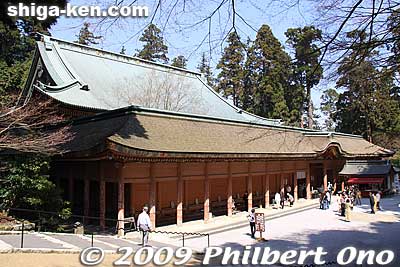 |
| Enryakuji temple's Konpon Chudo Hall, a National Treasure. |
- Enryakuji 延暦寺 - One of the largest temple complexes in Japan, Enryakuji is the headquarters of the Tendai Buddhist sect atop Mt. Hiei in Otsu, Shiga Prefecture. The temple was founded by Saicho to protect Kyoto from the demons of the northeast. Mt. Hiei is the cradle of Japanese Buddhism as many founders of Japanese Buddhist sects once trained on Mt. Hiei. They include Nichiren, Honen (Jodo-shu), Shinran (Jodo Shinshu), Eisai (Rinzai Zen), and Dogen (Soto Zen). The temple has monuments showing where these monks trained and portraits of them too. Enryakuji has three sprawling temple complexes on the mountain accessible by car and cable car. The temple complexes are connected by forested walking trails and mountain road. The main complex is called Todo where Enryakuji's huge, main worship hall called Konpon Chudo (National Treasure) is located. Konpon Chudo is famous for three candle lanterns burning an eternal flame for centuries, said to have been lit by the temple's founder Saicho. Enryakuji is also part of a World Heritage Site called Historic Monuments of Ancient Kyoto and noted for National Treasures. The main worship hall, called Konpon Chudo, is a National Treasure. Map
- Ishiyama-dera 石山寺 - Founded in 749, Ishiyama-dera, belonging to the Shingon Buddhist Sect, is the 13th Temple of the Saigoku Pilgrimage. The temple is noted for National Treasure architecture, cherry blossoms, and fall leaves. Also, 2008 was the 1000th anniversary of the epic novel "Genji Monogatari" or Tale of Genji written by Lady Murasaki Shikibu in 1008. Much of the novel was written in a room at Ishiyama-dera temple in Otsu, Shiga. Otsu celebrated the novel's millenium with various exhibitions and events mainly at Ishiyama-dera. The main worship hall and beautiful Tahoto Pagoda are National Treasures. The fall colors are also brilliant. Map
- Miidera 三井寺 - Established in the 7th century, Miidera temple, or Onjoji, is one of Otsu's major temples and one of Japan's four largest temples. It is the headquarters temple of the Tendai Jimon Buddhist Sect and former rival of Enryakuji temple on Mt. Hiei. It is a complex of numerous structures including National Treasures and Important Cultural Properties. The temple bell is famous for being one of the Omi Hakkei (Eight Views of Omi) depicted in ukiyoe prints. Also noted for cherry blossoms in early April and lit up at night. Map
- Hogonji 宝厳寺 - Chikubushima is a small island in northern Lake Biwa, Shiga Prefecture. The island has a large temple complex called Hogonji which includes buildings designated as National Treasures. One of Japan's Big Three shrines for Benzaiten (Benten), the goddess of water and music. Easily accessible by boat from Nagahama and Imazu Ports, Map
- Katata Ukimido 堅田 浮御堂 - Ukimido Floating Temple (Mangetsu-ji) jutting out into the lake is famous as one of the Omi Hakkei (Eight Views of Omi) and thus one of Shiga's most scenic views, even today despite the concrete (instead of wooden) stilts. Built to pray for lake transportation safety. Map
- Eigenji 永源寺 - Located in Higashi-Omi and established in 1361, Eigenji is a temple of the Zen Rinzai Buddhist Sect (Eigenji School) and well-known for fall colors with 3,000 maple trees. Although not part of the Koto Sanzan Temple Trio (all Tendai Buddhist temples), most visitors also visit Eigenji together with the Koto Sanzan temples. Accessible by bus taking 30-40 min. from Yokaichi Station on the Omi Railway Line or from Hyakusaiji. Admission 500 yen. Map
- Kongorinji 金剛輪寺 - Tendai Buddhist temple established in 741 and the middle temple in the Koto Sanzan Temple Trio. The main temple hall is a National Treasure houseing an 11-faced Kannon statue and 13 other statues designated as Important Cultural Properties. The 3-story pagoda is engulfed in foilage in autumn. Also see many little stone Jizo statues. Visit this temple before or after Saimyoji. Admission 500 yen. Map
- Hyakusaiji 百済寺 - Located in Higashi-Omi and established by Shotoku Taishi in 609, this is Shiga Prefecture's oldest temple and one of Japan's oldest. It belongs to the Tendai Buddhist Sect. Being the southern-most temple in the Koto Sanzan Temple Trio, visit it after Eigenji or Kongorinji Temple. The hillside garden gives a good view of Lake Biwa. The main temple hall worships an 11-faced Kannon statue carved by Shotoku Taishi. Admission 500 yen. Map
- Saimyoji 西明寺 - Established in 834, this Tendai Buddhist temple is the northern-most one in the Koto Sanzan Temple Trio. The main temple hall, designated as Japan's first National Treasure, houses statues of gods with a carving of the 12 Oriental Zodiac signs on the head. During fall, the autumn leaves are brilliant, and you can enter the three-story pagoda (National Treasure) to see the wall paintings. Near Amago Station on the Omi Railway Line. Admission 500 yen. Map
- Jorakuji Temple 常楽寺 - A stone's throw from Chojuji Temple in Konan, Jorakuji Temple (est. 708) of the Tendai Buddhist Sect boasts two National Treasures with its main hall and three-story pagoda. It is one of the Konan Sanzan Temple Trio accessible by bus from JR Ishibe Station. Map
- Chojuji Temple 長寿寺 - Meaning "Long Life Temple," Chojuji's Hondo temple hall is a National Treasure. It belongs to the Tendai Buddhist Sect and one of the Konan Sanzan Temple Trio along with Jorakuji and Zensuiji Temples. Fall colors are also nice. Accessible by bus from Ishibe Station or walk from Jorakuji. Map
- Chomeiji 長命寺 - The 31st temple on the Saigoku (Western Japan) Pilgrimage circuit, Chomeiji (Long Life Temple) worships the Kannon goddess dedicated to long life and good health. If you don't have a car, be prepared to climb up 808 stone steps. Or take a taxi to reach almost the top. Map
- Doganji Temple (Kogenji) 渡岸寺観音堂(向源寺) - In Takatsuki, Nagahama, the temple houses a beautiful 11-face Kannon statue designated as a National Treasure. Belongs to the Buddhist Jodo Shinshu Sect (Otani school). Map
- Kinomoto Jizo-in 木之本地蔵院 - Noted for its giant statue of Jizo, one of Japan's three largest Jizo statues. Jizo is the guardian deity of children and travelers. The temple's real name is Joshinji (浄信寺). It's along the old Hokkoku Kaido road in Nagahama going to the Hokuriku region. The temple's Kinomoto Jizo Ennichi Festival held on Aug. 22-25 is one of Kinomoto town's major events. Map
- Kiyotaki Tokugen-in 清滝・徳源院 - Noted for fall colors, this temple is dedicated to the graves of the Kyogoku clan spanning generations. Near JR Kashiwabara Station. Map
Shrines
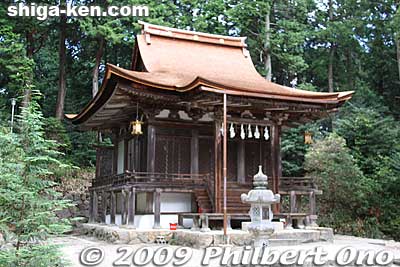 |
| Osasahara Shrine's Honden Hall, a National Treasure in Yasu. |
- Taga Taisha Shrine 多賀大社 - Shiga Prefecture's most popular Shinto shrine during New Year's with over 400,000 worshippers. Map
- Omi Jingu 近江神宮 - Shrine dedicated to Emperor Tenji who moved the capital to Otsu in 667. The shrine also holds the annual karuta card festival in Jan. Emperor Tenji also produced Japan's first clock which was a water clock. The shrine has a replica of this clock as well as a clock museum with thousands of clocks on display. Map
- Hiyoshi Taisha 日吉大社 - Near Sakamoto (Keihan Line) and Hie-zan Sakamoto (JR Kosei Line), this shrine is noted for National Treasures. The fall leaves in Nov. with 3,000 maple trees are also lit up at night 5:30 - 9 pm. In April, it holds the Sanno Festival. Map
- Shirahige Shrine - Lakeside shrine famous for the torii in the lake. "Shirahige" means white beard, and so people pray here for long life and longevity. The shrine is dedicated to a god named Sarutahiko. Map
- Karasaki Jinja Shrine 唐崎神社 - Shrine with numerous pine trees, including the famous century-old pine tree made famous by Hiroshige's woodblock print of the Omi Hakkei (Eight Views of Omi). One of them was titled, "Night Rain at Karasaki" showing the big pine in the rain at night. A branch shrine of Hiyoshi Taisha. Map
- Hokoku Jinja 豊国神社 - Dedicated to Toyotomi Hideyoshi, this shrine is a 3-min. walk from Nagahama Station. It holds the Toka Ebisu Festival on Jan. 9-11. Ebisu is one of the seven gods of good fortune. Map
- Hyozu Taisha Shrine 兵主大社 - Established in 717 (Nara Period), Hyozu Taisha worships a god named Onamuchi-no-Mikoto (大己貴命) also called Yachihoko (八千矛神). Onamuchi-no-Mikoto is a god of nation-building, farming, business, and medicine. It is the same god worshipped by Izumo Taisha in Shimane Prefecture. Yachihoko is known as the god of military strength. The shrine also has a nationally noted Japanese garden. A short bus ride from JR Yasu Station. Map
- Daiho Jinja 大宝神社 - Dedicated to Susano-O no Mikoto, this shrine is a short walk from JR Ritto Station. Holds a sumo festival in spring. Map
National Treasures
See a complete list of National Treasures in Shiga here: https://photoguide.jp/txt/National_Treasures_of_Shiga_Prefecture
Other Architecture
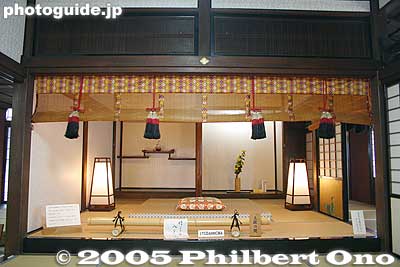 |
| Kusatsu-juku Honjin's Jodan-no-ma room reserved for daimyo warlords, emperors, etc. |
- Kusatsu-juku 草津宿 - Kusatsu-juku was the fifty-second station on the Tokaido Road (following Ishibe-juku) and the sixty-eighth station (following Moriyama-juku) on the Nakasendo Road. During the Edo Period, Kusatsu was an important stage or shukuba post town at the crossroads of the Tokaido Road and Nakasendo Road where daimyo warlords and other dignitaries lodged during their travels to and from Edo (Tokyo). They stayed at the exclusive Honjin which still remains. Map
- Gokasho 五個荘 - Famous for the grand, old homes of wealthy Omi merchants. Three of them are conveniently clustered together for us to see. They are the former residences of Tonomura Uhee (外村 宇兵衛), Tonomura Shigeru (外村 繁), and Nakae Jungoro (中江 準五郎). Map
- Koka Ninja House 甲賀流忍術屋敷 - The world's only authentic ninja house still in its original location. Revolving doors, trap doors, and underground tunnels helped the ninja escape or hide from the enemy. They avoided direct combat as much as possible. Called Koka-ryu Ninjutsu Yashiki, this house was the residence of Mochizuki Izumo-no-kami, the leader clan of the Koga ninja. Even actor Harrison Ford visited this house once. Located in Konan-cho, the former heart of the Koka ninja, popularly called Koga ninja. JR Konan Station on the Kusatsu Line is the closest train station. Map
- Koka Ninja Village 甲賀 忍術村 - Koka, Shiga Prefecture is known historically as a town of the Koga ninja. (Correct pronunciation is "Koka.") As a theme park, the Koka-no-Sato Ninjutsu-mura or Koka Ninja Village offers a good tourist sampling of ninja in a hidden village of former ninja houses transplanted to this "village." Admission is 1,000 yen for adults. Cheaper for students. Open 10 am - 5 pm. Free shuttle bus available from JR Koka Station. Phone: 0748-88-5000 Map
- Notogawa Waterwheel - Giant waterwheel made of wood in a large, lakeside park in Higashi-Omi. Map
Lake Biwa
Main article: Lake Biwa


- Lake Biwa 琵琶湖 - Japan's largest lake, covering one-sixth of Shiga. Japan's largest lake with white sand swimming beaches along the western shore such as Omi-Maiko, boat cruises, and islands such as Chikubushima. Great views of the lake can also be had from the surrounding mountains such as Mt. Hiei. The best place to learn about Lake Biwa (Biwako) is the Lake Biwa Museum in Kusatsu.
- Chikubushima 竹生島 - An iconic island in the middle of northern Lake Biwa. Easily accessible by boat from Nagahama, Hikone, and Imazu Ports, the island has a large temple complex called Hogonji which includes buildings designated as National Treasures. In recent years, the island has been suffering from a large colony of cormorants that damage the trees. Map
- Oku Biwako Parkway 奥琵琶湖パークウェイ - Scenic mountain road on a peninsula in northern Shiga Prefecture providing great views of Lake Biwa. Map
- Hie-zan Driveway 比叡山 and Mt. Hiei - Great views of Lake Biwa on the west side. Home of Enryakuji Temple. Map
- Takeshima 多景島 - Called "Island of Many Views," this is a small island (600 m circumference) having many different shapes depending on your viewpoint. A Nichiren temple and the priest's family are on the island. Accessible by boat from Hikone. Map
- Omi-Maiko 近江舞子, Wani, and other beaches on the western shore of Lake Biwa. Map
- Harie 針江 - Shin-Asahi in Takashima has a neighborhood called Harie where homes draw clean water from an ever-flowing spring directly from the ground into wells called kabata. A local NPO conducts tours of the area and homes with kabata. Map
- Sugaura 菅浦 - Small town along the northern shore of Lake Biwa in Nishi-Azai, Shiga Prefecture. It is a very scenic area with a nice lakeshore road and trail almost to the tip of the peninsula. Map
- Okishima (also Okinoshima) island 沖島 - Lake Biwa's largest island is inhabited by over 400 residents, mainly into fishing. It is a short boat ride away from Omi-Hachiman's Horikiri port. Map
- Kaizu-Osaki 海津大崎 - Along the northern shore of Lake Biwa, Kaizu-Osaki is one of the most scenic areas, especially when the cherry blossoms are in bloom. Map
- Katata Ukimido 堅田 浮御堂 - The Ukimido Floating Temple in Lake Biwa, Katata, Shiga Prefecture is famous as one of the Omi Hakkei (Eight Views of Omi). Today, it is supported by strong concrete pillars instead of wooden stilts of long ago. Map
- Otsu Waterfront - Otsu dominates southern and southwestern Shiga Prefecture. It has a long lake shore. Map
- Michigan Paddlewheel Cruise - Operates from Otsu for pleasure cruises on the lake. Other boat cruises start from Nagahama, Hikone, and Omi-Imazu to Chikubushima and Takeshima. Map
Smaller Lakes and Ponds
- Lake Yogo 余呉湖 - Small but scenic lake north of Lake Biwa. You can walk or bicycle around the lake. Accessible from Yogo Station on the JR Hokuriku Line. Map
- Mishima Pond 三島池 - With Mt. Ibuki in the background, Mishima Pond is very scenic during sunny winter days and the cherry blossom season. It is also well-known locally for migratory birds (especially ducks). Map
- Suigo Boat Ride 水郷めぐり - The Suigo boat ride in waterways and an attached lake called Nishi-no-ko connected to Lake Biwa. A major tourist attraction in Omi-Hachiman. Map
- Hayasaki Naiko attached lake - This was an attached lake to Lake Biwa until it was filled in as reclaimed land in 1970. A number of attached lakes in Shiga were reclaimed to make rice paddies amid a shortage of food after the war. This has proven to be detrimental to Lake Biwa's ecology, and now Shiga wants to restore Hayasaki's reclaimed land back to an attached lake. In Nov. 2001, part of the land was flooded with water as an experiment, and the ensuing plant and wildlife were observed. Map
Flowers, Gardens, & Parks

- Genkyu-en Garden 玄宮園 - Genkyu-en is a Japanese garden next to Hikone Castle. It was built as a castle garden in 1677 by Ii Naooki, the fourth lord of Hikone Castle. In Nov., the fall colors are beautifully lit up at night (6 pm - 9 pm). Admission 500 yen. Map
- Hokoen Park 豊公園 - Fronting Lake Biwa is noted for Nagahama Castle. It is also one of Japan's 100 Famous Cherry Blossom Spots. It also has plum blossoms. Map
- Kaizu-Osaki 海津大崎 - Along the northern shore of Lake Biwa, Kaizu-Osaki is one of the most scenic areas, especially when the cherry blossoms are in bloom. Map
- Mizunomori Water Botanical Garden 水生植物公園みずの森 Until 2015, there was a breathtakingly huge lotus pond at Karasuma Peninsula blooming in July-Aug. Sadly by summer 2016, the lotus field was decimated by sandy soil and an increase of methane gas. Water lilies and other aquatic plants are displayed inside the greenhouse. Adjacent to Lake Biwa Museum. Map
- Mishima Pond 三島池 - With Mt. Ibuki in the background, Mishima Pond is very scenic during sunny winter days and the cherry blossom season. Map
- Hyakusaiji 百済寺 - Located in Higashi-Omi and established by Shotoku Taishi in 609, this is Shiga Prefecture's oldest temple and one of Japan's oldest. The garden is full of azaleas in spring and fall leaves in Nov. Map
- Hyozu Taisha Shrine 兵主大社 - Established in 717 (Nara Period), this shrine's Japanese garden is designated as one of Japan's most famous. Map
- Nagisa Park 第一なぎさ公園 - Rape blossoms (nano-hana) bloom in winter from early-Jan. to mid-March at this lakeside park in Moriyama, Shiga Prefecture. About 12,000 flower plants carpet the area in yellow. Free admission. Map
- Lake Biwa Quasi-National Park - Lake Biwa is part of the Lake Biwa Quasi-National Park which is a rank lower than a National Park.
- Suzuka Quasi-National Park - Southeastern Shiga (Koka) is part of this park together with parts of neighboring Mie Prefecture.
*Also see Fall Colors below for gardens, parks, and temples to see in autumn.
Rivers
- Setagawa River 瀬田川 - The only river where water flows out from Lake Biwa. Major sights along the river include Seta Karahashi Bridge and the Seta Castle ruins. A riverboat cruise also runs. Rowing regattas are also held. The river also becomes very picturesque as you leave Lake Biwa. Map
- Samegai 醒井 - Samegai, in Maibara is a former stage town on the Nakasendo road. It is also famous for the Samegai Trout Farm, one of the largest in Asia and a clean river sprouting baikamo underwater flowers in summer. Map
- Hachiman-bori 八幡堀 - As a part of Hachiman Castle, Hachiman-bori canal enabled boats to ply to Hachiman Castle from Lake Biwa. It is famous for cherry blossoms in spring. Map
- Echigawa River
- Biwako Canal 琵琶湖疎水 - Not exactly a tourist attraction except the part where cherry trees are planted, but a vital water link for Kyoto and Osaka which depend on Lake Biwa for its water supply. Kyoto also has the Lake Biwa Canal Museum in Keage. Map
Mountains

- Mt. Ibuki 伊吹山 - Located in Maibara, Ibuki-yama is Shiga Prefecture's tallest mountain at 1,377 meters. Popular for flower viewing and hiking in spring and summer. It used to be popular for skiing, but the lack of snow has shutdown the gondola and ski lift. (Skiing is possible at Oku-Ibuki further north.) Going to the summit in summer is the best time when alpine flowers are in bloom, and short hiking trails make it very pleasant. There are r 1,200 species of wild flowers and plant life. It is one of Japan's 100 most famous peaks. The nearest station is Omi-Nagaoka Station from where local buses go to Mt. Ibuki. To reach the summit in summer from mid-July, take a bus from Sekigahara Station or Ogaki Station in neighboring Gifu taking you on the Ibuki-yama Driveway. Bus schedule iPad info in Japanese here: https://www.ibukiyama-driveway.jp/news/3652/ Map
- Mt. Shizugatake 賤ヶ岳 - One of the Shiga's best mountaintop viewpoints. Enjoy grand views of Lake Biwa and Lake Yogo. Go to JR Kinomoto Station on the JR Hokuriku Line, take a bus bound for Sugaura (菅浦) or Shindono (新道野), then get off at the Ooto (大音) bus stop. Walk to the chair lift. From Shizugatake, you can hike down to Lake Yogo and walk to JR Yogo Station to catch the train. There are two trails to Lake Yogo, one is short going directly down the mountain, while the other one is long, going along the mountain ridge before going down to the street. Map
- Hachiman-yama 八幡山 - At 271 meters high, this mountaintop was the site of Hachiman Castle built by Toyotomi Hidetsugu in 1585. Now home to Zuiryuji temple of the Nichiren Sect, some of the castle's stone walls still remain. Great views of Lake Biwa and Omi-Hachiman, as well as fall colors. Easily accessible via ropeway near Hachiman-bori canal. Map
- Mt. Mikami 三上山 - Nicknamed "Omi-Fuji" (Shiga's Mt. Fuji) since its conical shape resembles Mt. Fuji, Mt. Mikami-yama is a sacred mountain belonging to Mikami Shrine near the foot. The mountain is easy to spot from afar. An elevation of 432 meters makes it a fairly easy climb to the top, taking 40-80 min. depending on which trail you take. There is a steep trail (Front Mountain Path or Omote Tozando) and a less steep trail (Back Mountain Path or Ura Tozando) which takes longer to go up. From Yasu Station, take a short bus ride to Yamade-mae (or walk for 40 min.). From there, you can start going up the steep or less steep trail. Map
- Kan-onji - Mountaintop castle ruins in Azuchi. [ Map]
- Mt. Hakodate [ Map]
- Biwako Valley - Ski grounds. [ Map]
- Mt. Ryusen - [ Map]
Festivals
Shiga boasts interesting festivals every month of the year. For a complete list of festivals (matsuri), see Festivals of Shiga Prefecture.
Fall Colors

- Koto Sanzan Temple Trio 湖東三山 - Shiga's most famous place for fall colors are the following three Tendai Buddhist temples east of Lake Biwa. They also have buildings designated as National Treasures.
- Saimyoji 西明寺 - Established in 834, this temple is the northern-most one in the Koto Sanzan Temple Trio. The main temple hall, designated as Japan's first National Treasure, houses statues of gods with a carving of the 12 Oriental Zodiac signs on the head. During fall, the autumn leaves are brilliant, and you can enter the three-story pagoda (National Treasure) to see the wall paintings. Near Amago Station on the Omi Railway Line. Admission 500 yen. Map
- Kongorinji 金剛輪寺 - Established in 741 and the middle temple in the Koto Sanzan Temple Trio. The main temple hall is a National Treasure houseing an 11-faced Kannon statue and 13 other statues designated as Important Cultural Properties. The 3-story pagoda is engulfed in foilage in autumn. Also see many little stone Jizo statues. Visit this temple before or after Saimyoji. Admission 500 yen. Map
- Hyakusaiji 百済寺 - Located in Higashi-Omi and established by Shotoku Taishi in 609, this is Shiga Prefecture's oldest temple and one of Japan's oldest. Being the southern-most temple in the Koto Sanzan Temple Trio, visit it after Eigenji or Kongorinji Temple. The hillside garden gives a good view of Lake Biwa. The main temple hall worships an 11-faced Kannon statue carved by Shotoku Taishi. Admission 500 yen. Map
- Eigenji Temple 永源寺 - Located in Higashi-Omi and established in 1361, Eigenji is a temple of the Zen Rinzai Buddhist Sect (Eigenji School) and well-known for fall colors with 3,000 maple trees. Although not part of the Koto Sanzan Temple Trio, most visitors also visit Eigenji together with the Koto Sanzan temples. Accessible by bus taking 30-40 min. from Yokaichi Station on the Omi Railway Line or from Hyakusaiji. Admission 500 yen. Map
- Ishiyama-dera Temple 石山寺 - Founded in 749, this temple belongs to the Shingon Buddhist Sect. It is the 13th Temple of the Saigoku Pilgrimage. Lady Murasaki Shikibu is said to have written the epic novel, "A Tale of Genji" in a room at this temple. The fall colors are also brilliant. Map
- Hiyoshi Taisha 日吉大社 - Near Sakamoto (Keihan Line) and Hie-zan Sakamoto (JR Kosei Line), this shrine is noted for National Treasures. The fall leaves in Nov. with 3,000 maple trees are also lit up at night 5:30 - 9 pm. In April, it holds the Sanno Festival. Map
- Hyozu Taisha Shrine 兵主大社 - Established in 717 (Nara Period), this shrine's Japanese garden is designated as one of Japan's most famous. It is also one of Shiga's few Japanese gardens lit up at night during the fall colors in late Nov. A short bus ride from JR Yasu Station. Map
- Genkyu-en Garden 玄宮園 - Japanese garden next to Hikone Castle. It was built as a castle garden in 1677 by Ii Naooki, the fourth lord of Hikone Castle. In Nov., the fall colors are beautifully lit up at night (6 pm - 9 pm). Admission 500 yen. Map
- Kiyotaki Tokugen-in 清滝・徳源院 - Noted for fall colors, this temple is dedicated to the graves of the Kyogoku clan spanning generations. Pictures of neighboring Kiyotaki Shrine also included. Walkable from JR Kashiwabara Station. Map
- Oku Ibuki
Other Scenic Points
- Top of Otsu - Great views of Otsu and the southern tip of Lake Biwa from the top-floor restaurant in the Otsu Prince Hotel. The city's tallest building.
National Historic Sites
- Hikone Castle
- Azuchi Castle
- Omi-Hachiman
- Kusatsu-juku Honjin
- Battle of Anegawa River - Site of a major battle with Oda Nobunaga and Tokugawa Ieyasu defeating Azai Nagamasa and the Asakura clan on Aug. 9 1570. The area was left with so many dead that the river ran red, and local place names such as Chibara (Blood Field) stuck.
- Odani Castle
- Mt. Shizugatake battleground
- Minakuchi Castle
- Toju Shoin (藤樹書院跡)
- Sufukuji Temple ruins (崇福寺跡)
- Shigaraki-no-Miya Shrine ruins (紫香楽宮跡)
- Ukawa Shiju Hattai Sekibutsu-gun stone buddhas (鵜川四十八体石仏群)
- Anoshu Ishigaki stone wall (穴太衆積みの石垣)
Museums
- The Museum of Modern Art, Shiga (Shiga-kenritsu Kindai Bijutsu-kan) 滋賀県立近代美術館 - First-class modern art museum in a scenic park. Kind of out of the way, but worth a visit. Note: This museum is currently closed until April 2019 due to major renovations.
- Lake Biwa Museum - Learn about the lake's history and aquatic life. The aquarium is also worth seeing. In Kusatsu.
- Nagahama Castle Historical Museum - History museum within Nagahama Castle in Nagahama.
- Kurokabe Square - Glass museum and glassware factory in Nagahama.
- Shigaraki Ceramic Cultural Park - Birthplace of Shigaraki-ware pottery.
- Kunitomo Teppo no Sato Matchlock Museum - Small of exquisite museum of matchlock guns crafted by the Kunitomo gunsmiths who lived in Kunimoto (now part of Nagahama).
- Miho Museum - Art museum blended with nature in Shigaraki. Designed by I.M. Pei.
- Higashi-Omi Giant Kite Museum 東近江大凧会館 - Formerly the Yokaichi Giant Kite Museum, the Higashi-Omi Giant Kite Museum exhibits the giant kite used previously for the Giant Kite Festival, as well as many different kites from all over Japan and the world. Very impressive. Walk or take a bus from Ohmi Railways Yokaichi Station. Map
Hot Springs
- Ogoto Spa
- Sugatani Spa
- Kita-Omi Resort
Tourist Information
Tourist information is provided by Shiga Prefecture and the individual cities and towns.
- Otsu Office: Shiga Prefecture Tourist & Product Information Center (Shiga Kanko Bussan Joho Center)
In JR Otsu Station 1st floor, north side. Hours: 9 am - 6 pm, closed end of the year and New Year's. Map here
Address: Otsu Station Center 1st floor, Kasuga-cho 1-3, Otsu, Shiga. 滋賀観光物産情報センター 〒520-0055滋賀県大津市春日町1-3 おおつステーションセンター1階
Phone/Fax: 077-521-4288
Major train stations in Shiga have a tourist information office or booth such as: Otsu Station, Hikone Station, Nagahama Station, Kusatsu Station, Omi-Hachiman Station, Moriyama Station, Katata Station, and Omi-Imazu Station.
All cities and towns of Shiga have a tourism department. Their Web sites are listed on the shiga-ken.com (mostly Japanese only).
Photos
See over 15,000 photos of Shiga at Shiga Photos.
Related Articles
- Shiga Prefecture
- Lake Biwa
- National_Treasures_of_Shiga_Prefecture
- Festivals_of_Shiga_Prefecture
- History of Shiga Prefecture
- Shiga Prefecture Municipalities
- Shiga Prefecture Transportation
External Links
- shiga-ken.com - Comprehensive guide to Shiga.
| Municipalities of Shiga Prefecture 滋賀県 | ||
| Cities & Towns: Aisho-cho | Higashi-Omi | Hikone | Hino-cho | Koka | Konan | Kora-cho | Kusatsu | Maibara | Moriyama | Nagahama | Omi-Hachiman | Otsu | Ritto | Ryuo-cho | Taga-cho | Takashima | Toyosato-cho | Yasu | ||
| 愛荘町 | 東近江市 | 彦根市 | 日野町 | 甲賀市 | 湖南市 | 甲良町 | 草津市 | 米原市 | 守山市 | 長浜市 | 近江八幡市 | 大津市 | 栗東市 | 竜王町 | 多賀町 | 高島市 | 豊郷町 | 野洲市 | ||
| Prefectures of Japan | ||
| Aichi | Akita | Aomori | Chiba | Ehime | Fukui | Fukuoka | Fukushima | Gifu | Gunma | Hiroshima | Hokkaido | Hyogo | Ibaraki | Ishikawa | Iwate | Kagawa | Kagoshima | Kanagawa | Kochi | Kumamoto | Kyoto | Mie | Miyagi | Miyazaki | Nagano | Nagasaki | Nara | Niigata | Oita | Okayama | Okinawa | Osaka | Saga | Saitama | Shiga | Shimane | Shizuoka | Tochigi | Tokushima | Tokyo | Tottori | Toyama | Wakayama | Yamagata | Yamaguchi | Yamanashi | ||