Video link: https://youtu.be/yxn0KJ6v564
“Upopoy” is the nickname for the National Ainu Museum and Park which opened in Shiraoi, Hokkaido in July 2020. It means “singing together in a large group.”
Upopoy is Japan’s largest Ainu tourist attraction and research facility. It’s a large, complex of buildings spread out in a scenic lakeside park. There’s the National Ainu Museum, traditional Ainu village called “Kotan,” Cultural Exchange Hall for daily dance performances, Crafts studio demonstrating Ainu handicrafts, and workshop buildings for hands-on workshops.
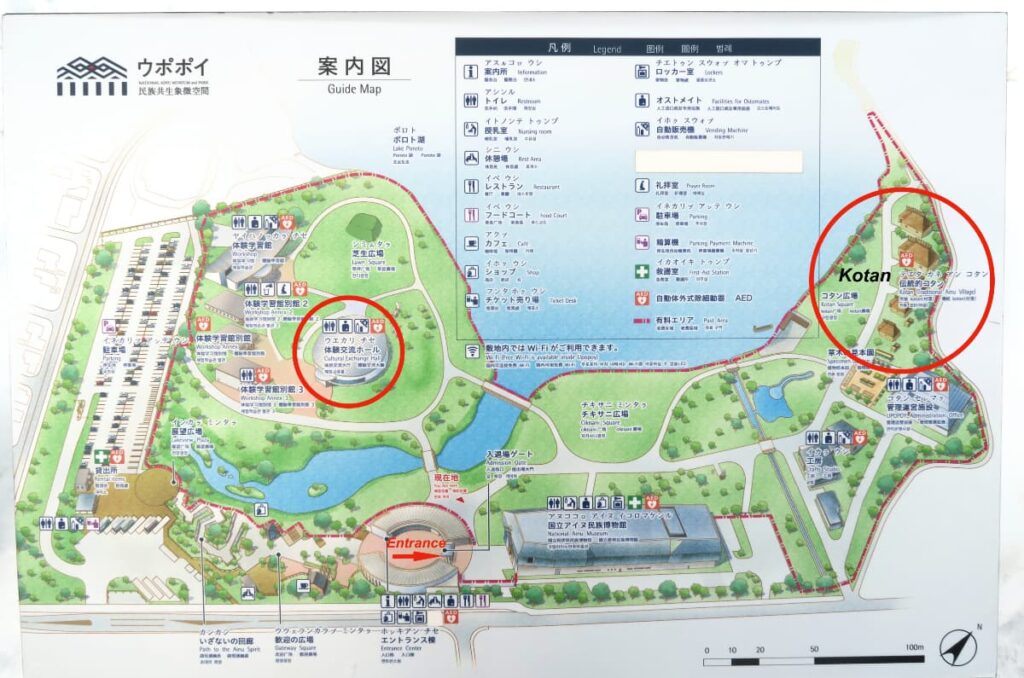
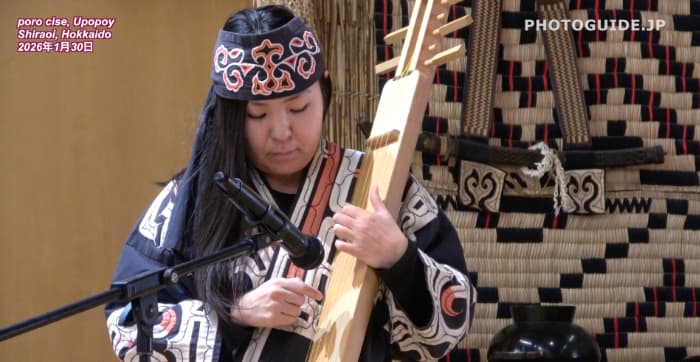
This video first gives a basic overview of Upopoy so you will know what’s what when you visit. There’s a lot to see and do, but the main attraction is the traditional music and dance performances which this video focuses on. Any first-time visit to Hokkaido should include Upopoy. It’s not too far from Sapporo or Shin-Chitose Airport.


The Ainu are an indigenous people mostly in Hokkaido. Their culture and language have had a strong influence in Hokkaido, especially in Hokkaido place names. Ainu culture and language are totally different from Japanese culture and language, so it’s quite fascinating. Ainu culture is also getting mainstream attention thanks to a popular manga, anime, and live action film called “Golden kamuy.”
Shiraoi is a Pacific coastal town in southwestern Hokkaido where the Ainu have long lived. Early Ainu were attracted to Shiraoi’s ocean, rivers, lakes, forests, and mountains. It was a rich natural environment for hunting and harvesting whatever they needed for daily living. They believed everything in nature had its own deity, so it was a sacred place. However, the traditional Ainu way of life is no more. Nobody lives in thatch houses anymore. Most all Ainu today live a modern life like any normal Japanese. The stereotypical, old photos of Ainu you see are also long past.
The Ainu are an indigenous people originally living in northern Honshu, Hokkaido, Sakhalin, and the Kuril islands. They have their own culture, customs, language, and beliefs. “Ainu” literally means “humans” in contrast to “kamuy” divine spirits or deities.
Video Contents
About Upopoy
- Preview https://youtu.be/yxn0KJ6v564
- About Upopoy https://youtu.be/yxn0KJ6v564?si=LHuNMsnNNblYHOmf&t=167
- About the Ainu https://youtu.be/yxn0KJ6v564?si=uD3eHM6-f2jZOMRI&t=219
- Shiraoi Poroto Kotan https://youtu.be/yxn0KJ6v564?si=-f-VlDpl1gX0mLd9&t=366
- National Ainu Museum https://youtu.be/yxn0KJ6v564?si=zhJZuZ3E0GjXcqA6&t=393
- Cultural Exchange Hall https://youtu.be/yxn0KJ6v564?si=URfc9ILwZXNlpx0j&t=494
- Crafts Studio https://youtu.be/yxn0KJ6v564?si=78GRj82jowoUPTtY&t=548
- Workshops https://youtu.be/yxn0KJ6v564?si=Pt_vN83KcEdlkK8z&t=575
- Eateries https://youtu.be/yxn0KJ6v564?si=kR7O1-eaV2R-yMYk&t=605
Ainu performances at Upopoy
- About Ainu dances https://youtu.be/yxn0KJ6v564?si=KOwzLT9Th1DIJRvg&t=634
- Kotan Ainu village https://youtu.be/yxn0KJ6v564?si=stm9fby7csf51NVK&t=710
- Kotan presentation at poro cise (Big House) https://youtu.be/yxn0KJ6v564?si=D5xhekVF2xl1AJ4U&t=816
- Mukkuri mouth harp https://youtu.be/yxn0KJ6v564?si=zUbQBEZ2KecpAKf9&t=1159
- Tonkori zither https://youtu.be/yxn0KJ6v564?si=DH9Hfzk8gkgj_rkd&t=1335
- Tonkori Heciri (dance) https://youtu.be/yxn0KJ6v564?si=d86Cpk5_HSQNNwWe&t=1484
- iyomante rimse (dance) https://youtu.be/yxn0KJ6v564?si=yhckGsQJKE_PkWb0&t=1646
Tourism Expo Japan 2024 (Tokyo Big Sight)
- Mukkuri mouth harp https://youtu.be/yxn0KJ6v564?si=7XpiizQxpr43XMIM&t=1802
- Crane Dance https://youtu.be/yxn0KJ6v564?si=vyz6IUU5hezV6Bva&t=1989
- Sword Dance https://youtu.be/yxn0KJ6v564?si=EpDVglJx8i0ovqu1&t=2119
- About iyomante ceremony https://youtu.be/yxn0KJ6v564?si=lJyyjVlGGM5QpuiV&t=2236
- Iyomante rimse (dance) https://youtu.be/yxn0KJ6v564?si=utmNVglHNqjCFFkX&t=2427
Shiraoi Port, Hokkaido
- Upopoy prayers https://youtu.be/yxn0KJ6v564?si=zEGTgLcr00l0K5tC&t=2585
- Yai-sama-nena (Impromptu Song) https://youtu.be/yxn0KJ6v564?si=GddE6WTT3WIr090u&t=2708
- Pirka Song https://youtu.be/yxn0KJ6v564?si=g2aBZt5v_QP5JpZQ&t=2799
- Duo mukkur mouth harp (Bon voyage) https://youtu.be/yxn0KJ6v564?si=tB40kwcQRdukWjt6&t=2878
Upopoy Visitors’ Tips
- Allow as much time as you can (preferably the entire day) at Upopoy.
- I spent the entire day there and still couldn’t see or do everything.
- Before entering Upopoy, buy takeout food outside the entrance. (No eateries inside the park as of Jan. 2026.)
- After entering Upopoy, go to the Cultural Exchange Hall’s ticket booth to get free tickets for scheduled dance performances.
- Check program times at the kotan village (especially poro cise).
- For hands-on activities, workshops, and lessons, see the official website for the day’s schedule. https://ainu-upopoy.jp/en/
Tips for Upopoy in winter
- Closing time (usually 5 pm) is earlier than in warmer months.
- Shiraoi gets less snow than Sapporo, so it’s easier to get around.
- Even with snow, the staff will clear the snow from the park’s main walking paths, so it’s usually not a problem.
- If you wear spikes on your shoes, you need to take them off in the museum, etc.
- In winter, most things are held indoors. In warmer months, there are outdoor activities and dances performed on the outdoor stage in the kotan village.
- Fewer visitors in winter, so easier to see everything.


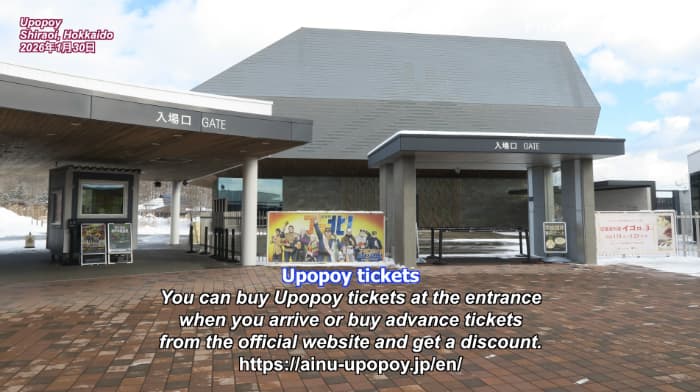
You can buy Upopoy tickets at the entrance when you arrive. You can also buy advance tickets online from the official website and get a discount. https://onlineticket-upopoy.jp/en/
Getting to Upopoy
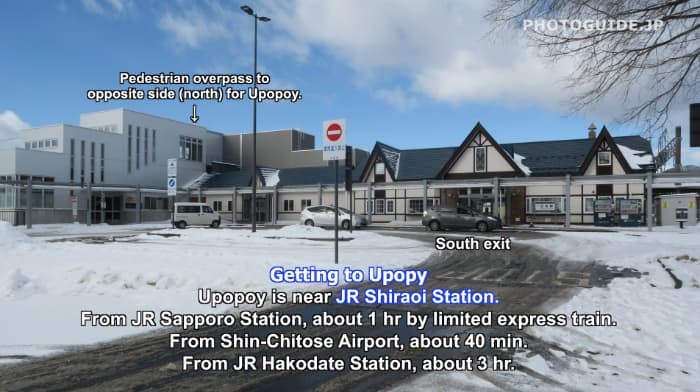
Upopoy is near JR Shiraoi Station.
From JR Sapporo Station, about 1 hr by limited express train.
From Shin-Chitose Airport, about 40 min.
From JR Hakodate Station, about 3 hr.
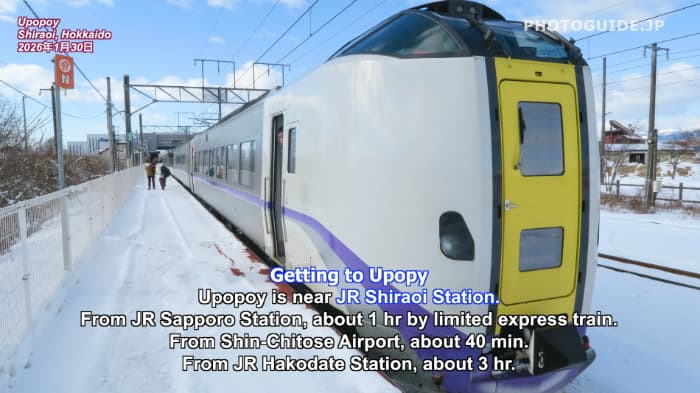

The station does not have a gift shop.

After exiting JR Shiraoi Station, go right, enter this door and go up the stairs or elevator to the pedestrian bridge.
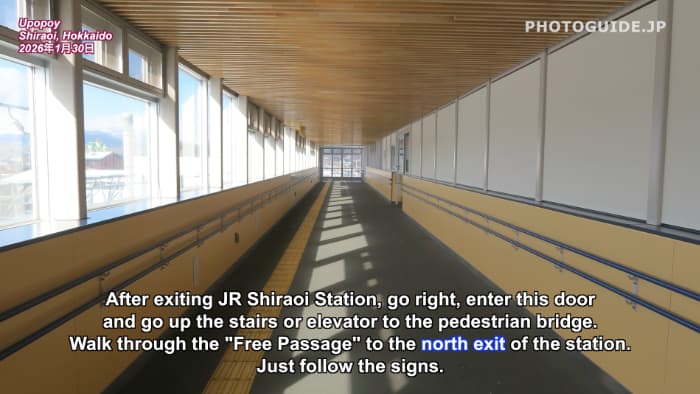
Walk through the “Free Passage” to the north exit of the station.
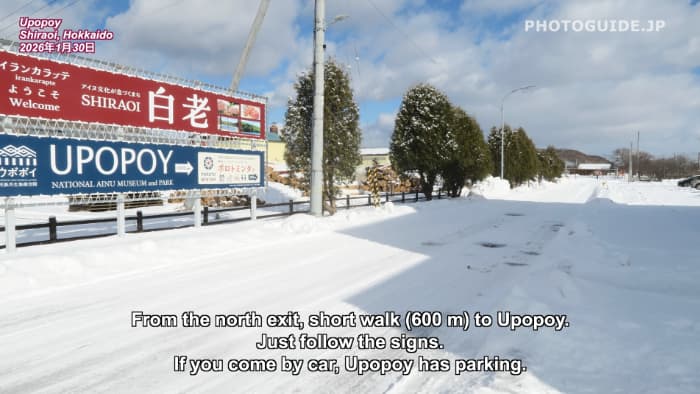
From the north exit, short walk (600 m) to Upopoy. Just follow the signs.
If you come by car, Upopoy has parking.
Upopoy is also near Shiraoi Port where cruise ships can dock for a day trip by chartered bus.
Essential Ainu Vocabulary
Upopoy uses the Ainu language to name their facilities, activities, and things. The Japanese equivalent is in katakana. Ainu language romanization is slightly different from the Hepburn system. English also usually provided.
Ainu – humans, name of indigenous people in Hokkaido
kamuy – god/goddess, deity (pronounced “kamui”)
Upopoy – Nickname of National Ainu Museum and Park, meaning “singing together in a large group.”
kotan – Traditional Ainu village
cise – Traditional Ainu house (pronounced “chee-say”)
rimse – singing dance
iran-karapte – Hello, greetings, konnichiwa
mukkuri – mouth harp
tonkori – zither
iyomante – Bear spirit send-off ceremony
kamuy mosir – divine world of deities
Ainu mosir – world of humans
Ezo – former name of Hokkaido until 1869 poroto – big lake
iya-irai-ke-re! – Thank you!
-betsu or -nai – river (found in many Hokkaido place names such as Noboribetsu)
wajin – Japanese people from Japanese mainland


